Load Shedding and HVAC Resilience Strategies for Gauteng
Load Shedding and HVAC Resilience Strategies for Gauteng
How Pretoria businesses can protect airconditioning and mechanical systems from power instability
Power interruptions have become part of operational reality across Gauteng. For facilities that depend on continuous airconditioning, ventilation, pumps, and mechanical systems, load shedding is more than an inconvenience. It creates electrical stress, mechanical strain, and financial risk. This article explains how power instability impacts HVAC infrastructure, what protection protocols Pretoria businesses should implement, and how structured resilience planning protects uptime, equipment life, and budgets.
The Hidden Impact of Load Shedding on HVAC Systems
When electricity supply is interrupted and then restored, HVAC systems experience sudden shutdown and restart cycles. Unlike controlled shutdown procedures, load shedding cuts power without warning.
This creates several risks:
Voltage fluctuations during restoration
Inrush current surges at restart
Compressor and motor overload
Variable Speed Drive faults
Pump and fan mechanical shock
Repeated exposure accelerates wear. Bearings, windings, couplers, and drives absorb stress every time power drops and returns.
In Pretoria’s commercial and industrial environments, where systems may operate 12 to 18 hours per day, repeated cycling significantly shortens equipment lifespan.
Electrical Stress After Power Restoration
The moment electricity returns, multiple systems attempt to restart simultaneously. This creates high inrush current demand, especially for:
Compressors
Three phase motors
Cooling tower pumps
Extraction fans
Without staggered restart controls or protective relays, motors draw excessive current. Over time, this degrades insulation and increases heat buildup inside windings.
Frequent electrical surges can also trigger Variable Speed Drive faults, particularly where harmonic filtering or surge protection is inadequate.
Proper power quality management is essential for long term reliability.
Mechanical Consequences of Sudden Shutdown
Load shedding does not only affect electrical components. Mechanical systems also suffer.
When pumps and fans stop abruptly:
Hydraulic pressure drops instantly
Couplers experience shock loading
Lubrication circulation stops
Temperature regulation halts
On restart, components accelerate from zero to full speed within seconds. Repeated abrupt cycling contributes to shaft misalignment, seal damage, and bearing wear.
Over months or years, this creates a pattern of premature failure that many facilities mistakenly attribute to poor equipment quality rather than unstable power conditions.
Common HVAC Failures Linked to Power Instability
Across Pretoria facilities, recurring faults often trace back to load shedding exposure.
Typical issues include:
Compressor tripping and overheating
Burnt motor windings
Drive parameter loss after outage
Cooling tower imbalance
Pump seal leakage after restart
Loose electrical terminations due to thermal cycling
When these failures repeat, the root cause is frequently power fluctuation rather than component design.
Understanding this distinction allows facilities managers to shift from reactive repair to resilience planning.
Practical Resilience Protocols for Gauteng Facilities
Protecting HVAC infrastructure during load shedding requires structured safeguards.
Install Surge Protection and Voltage Monitoring
Dedicated surge protection devices reduce damage from sudden voltage spikes. Voltage monitoring relays prevent motors from restarting until supply stabilises.
Implement Staggered Restart Systems
Instead of allowing all equipment to restart simultaneously, staggered timers sequence compressors, pumps, and fans. This reduces peak inrush demand and mechanical shock.
Protect Variable Speed Drives
VSDs must be configured with proper restart logic. Backup parameter storage ensures settings are not lost during outages. Drive enclosures must be adequately ventilated to prevent overheating when supply fluctuates.
Conduct Post Outage Inspections
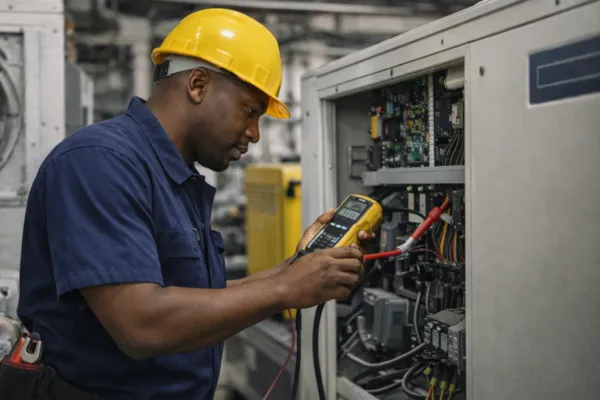
Regular inspections following heavy load shedding periods help identify:
Loose terminations
Overheated cables
Bearing noise changes
Abnormal vibration
Coupler misalignment
Early detection prevents larger breakdowns.
Backup Power Integration Considerations
Many Pretoria businesses install generators or UPS systems to maintain operations during load shedding. However, improper generator integration introduces additional risk.
Key considerations include:
Generator sizing aligned with HVAC startup load
Automatic transfer switch calibration
Harmonic compatibility with VSD driven systems
Cooling and ventilation of generator rooms
Proper earthing and bonding
A generator that cannot handle compressor startup load can cause repeated tripping and voltage instability, compounding rather than solving the problem.
Professional assessment ensures backup power strengthens resilience rather than introducing new stress points.
Financial Implications of Poor Power Protection
Unprotected HVAC systems expose facilities to multiple financial risks:
Emergency call out costs
Motor rewind expenses
Unplanned production downtime
Food spoilage in hospitality environments
Tenant dissatisfaction in commercial buildings
Increased insurance risk
In industrial settings, even a single cooling failure can halt operations for hours. The cost of downtime often exceeds the cost of preventive resilience upgrades.
Resilience planning should be viewed as risk management, not discretionary expenditure.
Load Shedding and Cooling Towers
Cooling towers are particularly vulnerable to unstable power.
When pumps stop suddenly:
Water circulation halts
Heat rejection stops
System pressure equalises abruptly
On restart, imbalance and vibration may occur. Repeated cycles stress impellers and shafts.
Routine inspection after prolonged load shedding phases ensures:
Balanced operation
Stable motor current draw
No structural vibration
Consistent airflow
Cooling tower performance directly impacts chiller efficiency and overall building climate control.
Industrial Facilities and Production Risk
Manufacturing plants across Gauteng rely on stable temperature and ventilation for process integrity.
Inconsistent HVAC performance may affect:
Product quality
Environmental compliance
Worker safety
Machinery cooling
Load shedding resilience is therefore not only about comfort. It is about operational stability and compliance.
Industrial facilities benefit from integrated electrical and mechanical inspections that address motors, drives, pumps, couplers, and ventilation systems together.
Strategic Planning for Long Term Reliability
Pretoria businesses that treat load shedding as a temporary inconvenience often remain reactive. Those that adopt structured resilience planning experience fewer failures and lower lifecycle costs.
A strategic approach includes:
Annual power quality assessment
HVAC resilience audit
Drive inspection and parameter verification
Motor insulation testing
Bearing temperature trend analysis
Coupler alignment checks
Backup power load testing
When electrical and mechanical systems are evaluated together, weaknesses are identified before failure occurs.
Why ACCM Airconditioning Supports HVAC Resilience in Pretoria
ACCM Airconditioning provides integrated electrical and mechanical expertise across Pretoria and Gauteng.
Field services include:
Bearing temperature and noise checks
Coupler inspections
Leak and vibration analysis
Variable Speed Drive inspections
Motor current and insulation testing
The in house workshop supports motor rewinds up to 250 kW, pump servicing, gearbox repairs, and VSD supply.
This integrated capability ensures that vulnerabilities identified during inspections are resolved quickly, reducing downtime and protecting long term asset value.
Facilities managers benefit from working with a partner that understands both electrical and mechanical stress factors caused by load shedding.
“Power instability is now part of operating in Gauteng. The difference between frequent breakdowns and stable performance lies in preparation, inspection, and proper protection protocols.”
ACCM Airconditioning Field Services Team
Conclusion
Load shedding places measurable stress on airconditioning, ventilation, pumps, and industrial mechanical systems. Sudden shutdown and restart cycles accelerate wear, increase failure rates, and expose facilities to downtime risk.
However, structured resilience protocols, surge protection, staggered restart systems, drive configuration, and integrated inspections significantly reduce long term impact.
For Pretoria businesses, resilience is no longer optional. It is a core component of responsible facility management.
Proactive planning protects equipment, budgets, and operational continuity in an environment where power instability remains a reality.